Installation adds another thread to architecture professors’ textile research
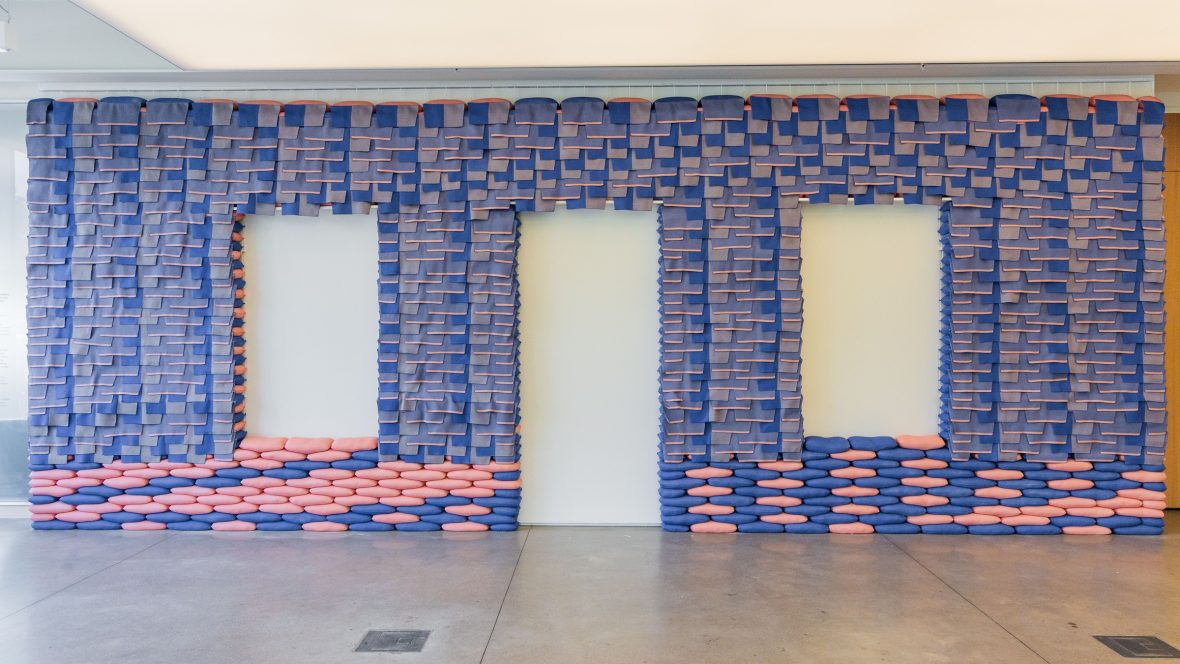
With its simple front door flanked by two windows, the wall section that architecture professors Nathaniel Elberfeld and Alexandra Waller recently built at Washington University in St. Louis recalls the mill houses in Charlotte’s Belmont neighborhood where the couple lives.
That these mill houses are an historical artifact of a once thriving textile industry becomes curiously relevant upon examination of this installation’s building material. “Neighbors to Your Right and Left” is a textile wall: the sandbag “bricks” and “shingle” cladding are all made of fabric produced on an industrial knitting machine.
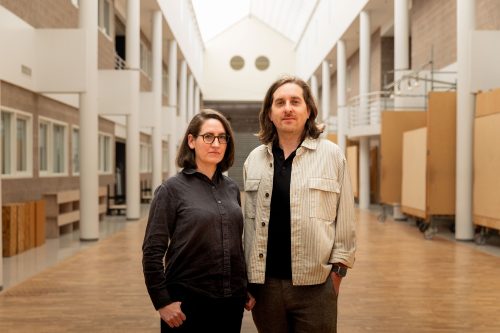
“Neighbors to Your Right and Left” is this year’s installation for the Weil Project Wall, a space in WashU’s Weil Hall that showcases invited alumni work. It was created by Elberfeld and Waller with their longtime collaborator, Lavender Tessmer. All three are alumni of WashU’s Sam Fox School of Design and Visual Arts’ architecture program.
They are also the founders of Teltta, the research and computational design collective they formed in 2020 after a dozen years of friendship and collaborative work.
“Teltta is Finnish for ‘tent,’” Elberfeld said. “It’s a big tent for the design and research that the three of us do.”
Much of that research has involved incorporating textile techniques into architectural design, an area of investigation that they discovered while pursuing Master of Architecture degrees at WashU.
The history of textiles in architecture – of textiles as architecture – is as old as the history of architecture, itself, with early dwellings made with skins, hair, grasses and eventually fabrics. Much of the modern exploration of textile architecture has expanded that idea of textiles as surface, designing and executing canopies and tents out of non-textile materials.
Nearly a decade ago, Elberfeld, Waller and Tessmer decided to take textile architecture research in a different direction, inspired by bobbin lace. They learned the traditional lacemaking technique, but instead of thread, they used carbon fiber, which Waller said is “lightweight, but strong” and could perhaps play a structural role in architecture.
“We were interested in the idea that you could use carbon fiber to reinforce concrete, subverting the heaviness of concrete,” said Elberfeld.
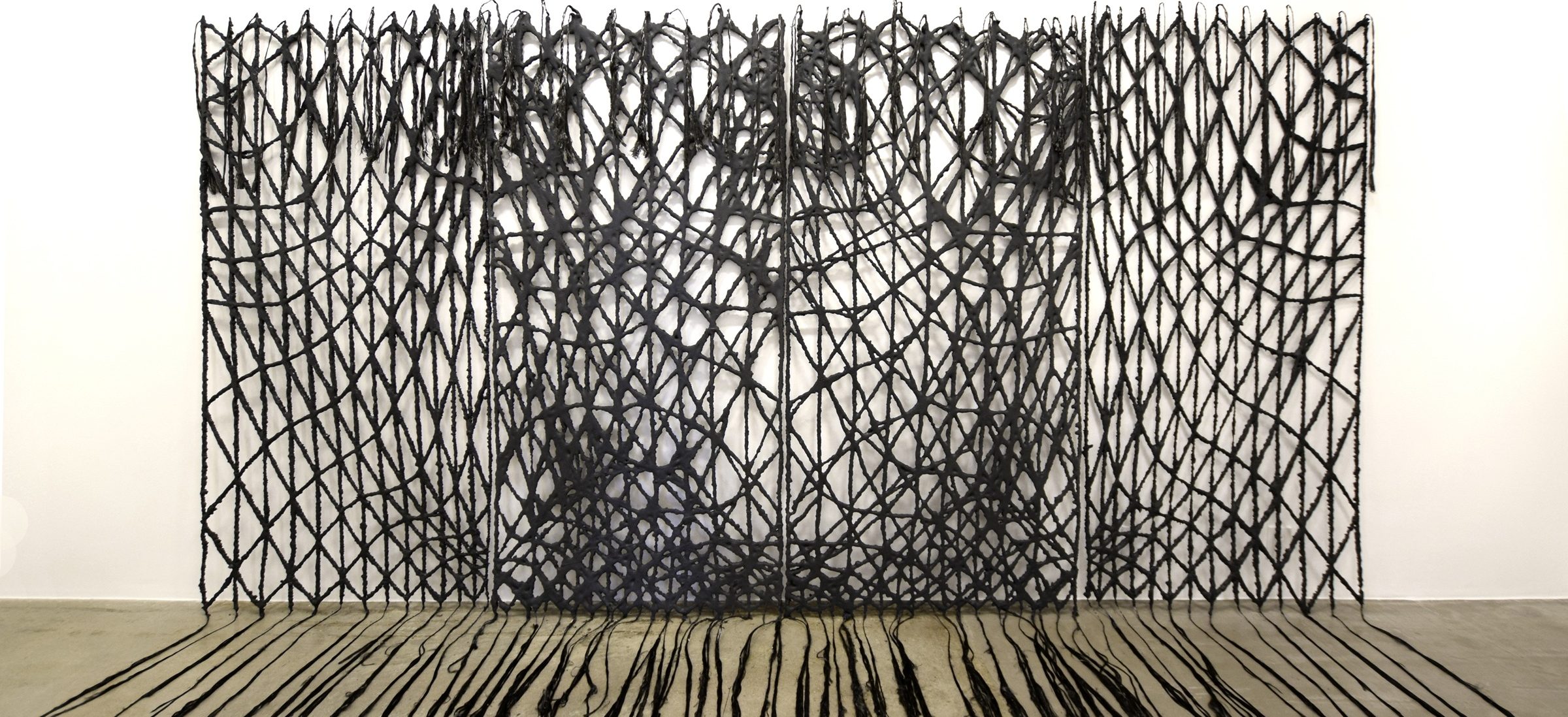
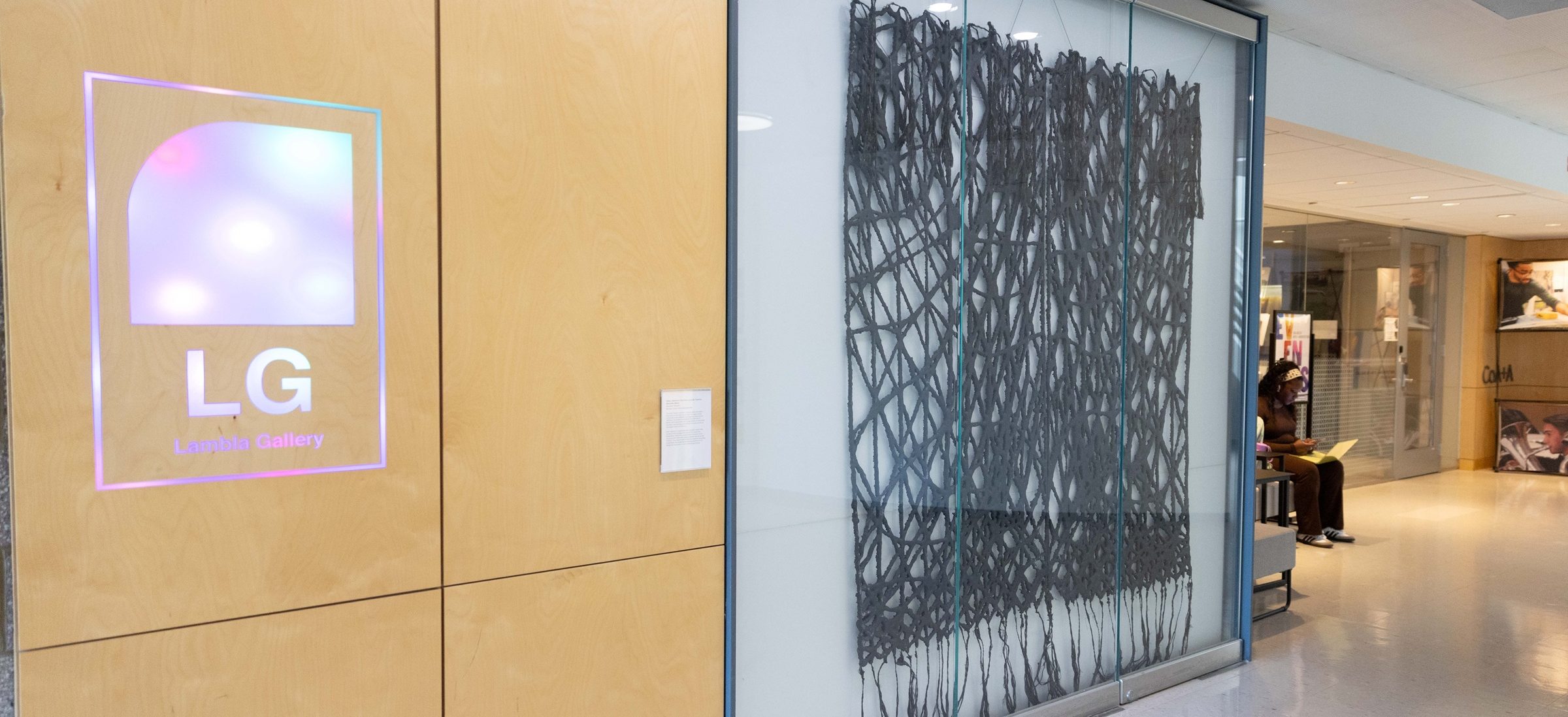
The result was “Concrete Tapestry,” a series of four large “lace” panels that were first displayed in 2018 in St. Louis. Two of the panels can now be seen in the Storrs building.
Each panel is made of braided carbon fiber that has been coated in resin, covered in a rock aggregate and then dipped into a concrete bath, “like dipping candles in wax,” said Waller.
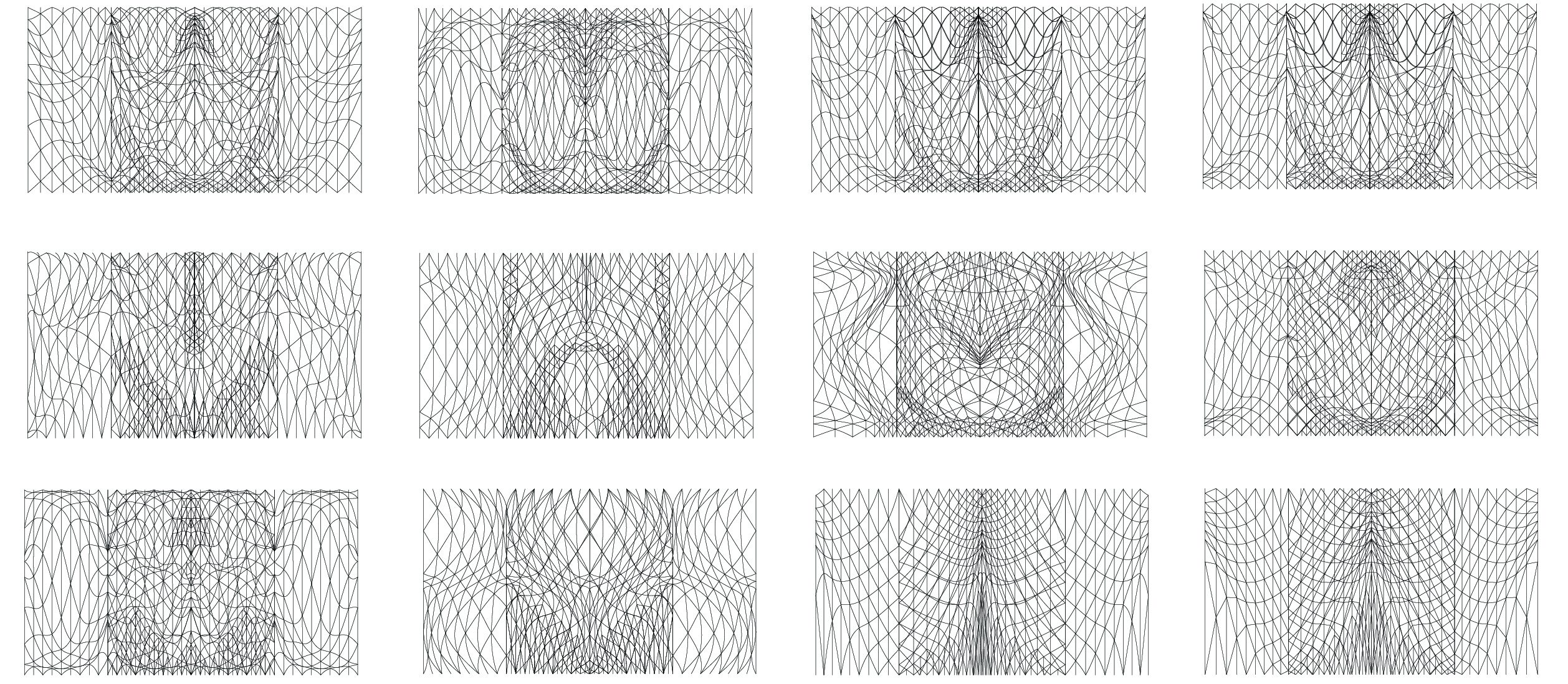
The panels’ patterns were generated through digital prototyping.
“We were able to make dozens of different designs and test the prototypes digitally,” said Elberfeld. Once the team had chosen the design for each panel, it was printed out as a large digital plot that allowed for a one-to-one relationship between the digital and physical outputs. A particular benefit of the bobbin lace technique, Elberfeld said, is the fidelity of the design’s physical manifestation to its digital iteration.
Two years later, Elberfeld, Waller and Tessmer formally presented their case for lace at the 40th Annual Conference of the Association of Computer Aided Design in Architecture, then ended 2020 with a major outdoor installation for the Design Seaport Biennial 2020 in Boston. “Wallessness” expanded the technique of working with bobbin lace from two to three dimensions to create a spatial and experiential installation.
-
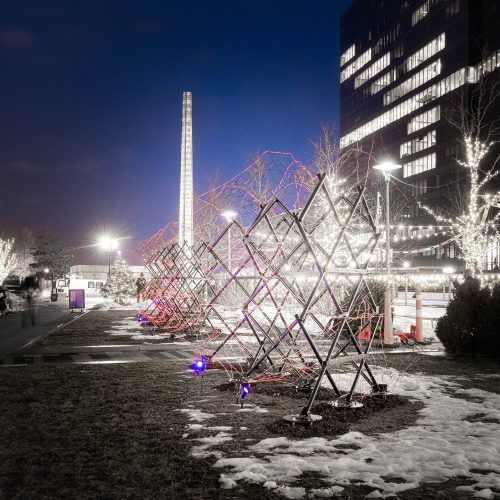
"Wallessness," designed and fabricated for the Design Seaport Biennial 2020 in Boston.
-
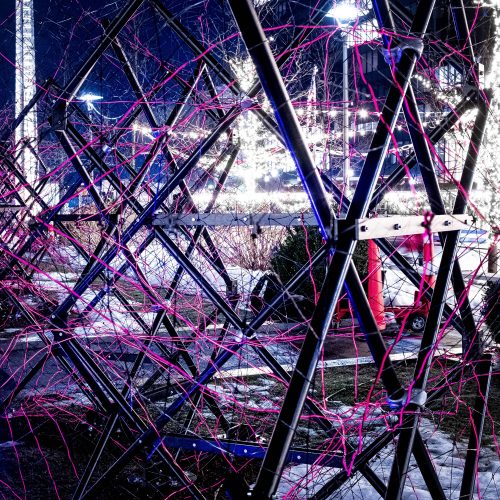
The project "dematerializes the wall by substituting masonry blocks with lightweight structural modules made by hand braiding heat-activated carbon fiber strands together with fluorescent and retro-reflective fibers," wrote the designers.
-
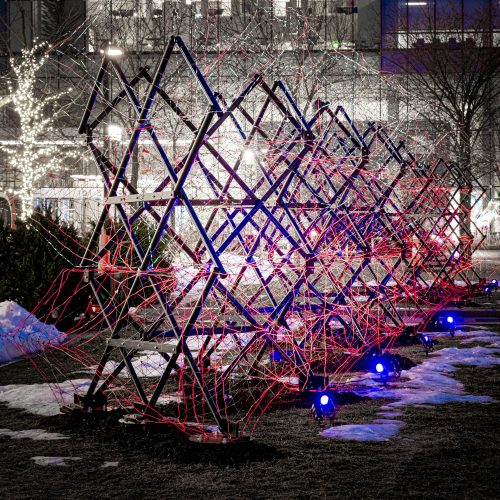
No longer heavy, thick or impermeable, this wall "transfigures a typology of exclusion and division into one of inclusion and connection," reads the project description.
In “Beyond braiding: Transcending artifact-centered conceptions of craft in digital fabrication,” a paper for the Design Research Society 2024 Biennial Conference, the trio proposed a framework for craft-based digital work and introduced new terminology to define its theoretical boundaries, using the complex design and fabrication of “Wallessness” to illustrate their concepts.
The Weil Project Wall has provided Elberfeld, Tessmer and Waller the opportunity for a new research agenda. Tessmer, now on the faculty of Clemson University in South Carolina, has an industrial knitting machine.
“We wanted to make another architectural piece, but we didn’t want to repeat things that already have a lot of research activity,” said Waller. “How could we use the knitting machine to almost 3D print a building?”
Once again, the project is the result of both digital computation and physical hand-making. The fabric design (incorporating three yarn colors) and the pattern for the placement of “shingles” and “bricks” were developed computationally, but the installation was all physical labor: the Teltta team, along with student helpers from WashU, formed an assembly line and filled nearly 1,000 knit bags with expanded glass pellets and built “Neighbors to Your Right and Left” over the course of eight days.
-
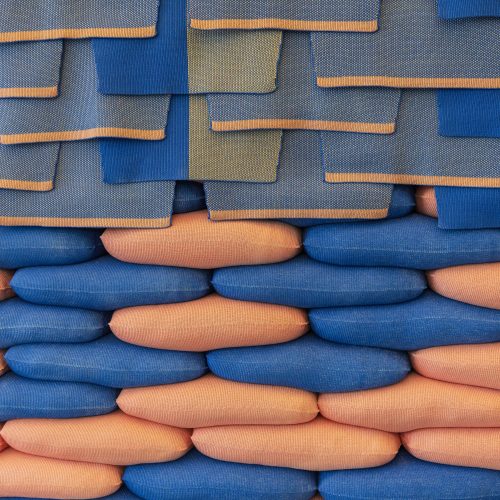
The sandbags are also a reference to the periodic flooding of the Mississippi River, which runs through St. Louis.
-
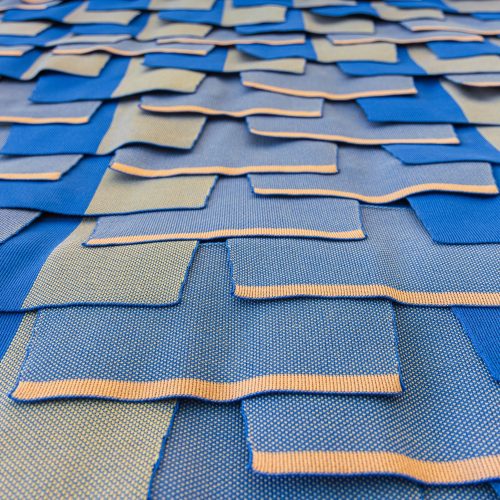
The fabric was digitally designed and industrially knitted using three yarn colors.
-
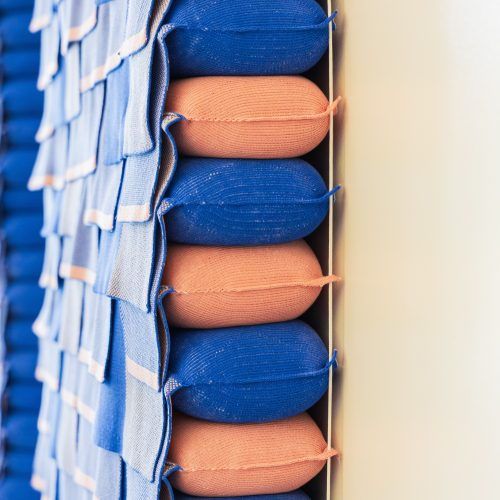
The sandbags are stacked according to the logic of "cellular automata," with the final pattern determined by eight placement rules.
The installation will remain through the 2026-27 academic year, during which the trio will return to give a lecture on the project.
“We hope viewers are intrigued, curious, and delighted by the work,” the Teltta team said for an article on the Sam Fox School’s website, “and that it makes a good neighbor itself during its time at the Sam Fox School!”
Written by Meg Whalen. Photos courtesy of the Sam Fox School and Teltta. Top photo by Toby Schuetze.