Grad tackles public health challenges with good urban design
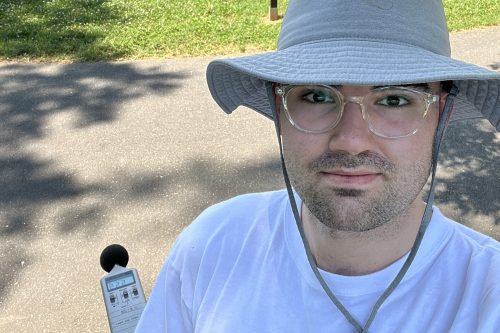
Erik Darden ran track as an undergraduate at Lenoir-Rhyne University. As he beat the pavement across Hickory, North Carolina, he took note of the strengths and weaknesses in the town’s urban design.
“There’s no better way to understand your city than by doing distance running around it,” he said in a recent interview.
A community health major, Darden was particularly interested in the impact of urban design on public health.
“Many public health problems are created by poor urban design or outdated design principles,” he said, while conversely, “good design principles are good for most public health issues.”
When Darden came to UNC Charlotte to pursue graduate studies in public health, he realized that he could help bring about better health conditions by studying the built environment. He enrolled in the Master of Urban Design program, earning his degree on August 7.
UNC Charlotte offers the only Master of Urban Design degree in the state. The 12-month program is built on the premise that urban design is a fusion of physical design, policy and implementation strategies. Charlotte is the program’s living laboratory, but in addition to in-depth study of our fast-growing city, the curriculum includes a summer study abroad component.
Darden joined his cohort and MUD Director Ming-Chun Lee in Taipei, Taiwan, this summer. It was his first trip abroad.

While there, Darden paid special attention to the city’s noise. Even though Taipei is larger, he discovered that there was frequently much less noise pollution than he expected – or than he experienced in Charlotte.
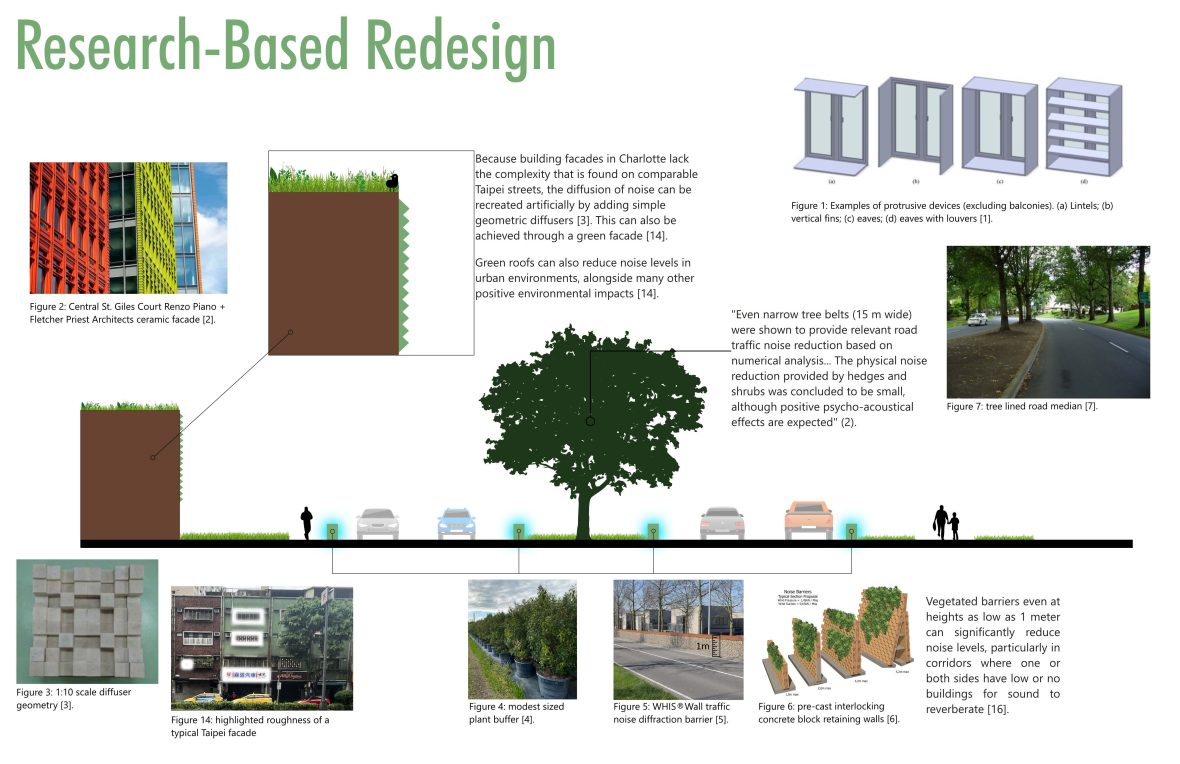
“They had all the right design guidelines there to mitigate noise,” he said, things like complex, multifaceted facades and green roofs to absorb sound, or raised pedestrian paths to separate people from traffic noise.
Like air pollution, noise pollution is a major contributor to poor public health, Darden said. Returning from Taipei, he turned his attention to Charlotte: “How can we design our streets to mitigate noise?”
He began his research, reading peer-reviewed scientific studies of noise pollution in urban environments while also gathering noise data in local areas to document his personal experience of urban sound.
Darden’s final thesis, “The Sound of Architecture,” proposed design principles to reduce noise pollution on specific Charlotte streetscapes, such as the intersection of Parkwood Avenue and North Caldwell Street, near Optimist Hall.
Now, Darden is off to put his blend of public health and urban design knowledge to work. On the day before leaving Taipei to return home, he had a successful job interview. He becomes a regional planner with the Mount Rogers Planning District Commission in Marion, Virginia, on August 10.
Even though Darden’s design training has focused on challenges in major cities, he’s “super excited,” he said, to be working in the southwestern region of Virginia, an area not too different from his hometown of Hickory. He will take on issues like climate resilience and disaster preparedness, public transportation, and GIS mapping, giving guidance to counties and towns across the region.
Written by Meg Whalen. Images courtesy of Erik Darden.