Architecture professor co-edits new book that explores the design potential of fungi
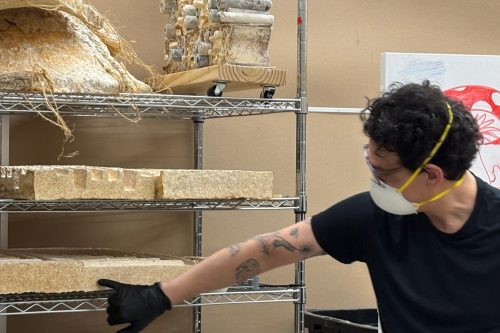
Associate Professor of Architecture Jonathan Dessi-Olive had already been working with mushrooms for about five years when he first met Assia Crawford. Both researchers were attending a conference in Denmark in 2022 and discovered their shared interests in earthy materials and digital fabrication. They also “met all these mushroom people,” Dessi-Olive said, and began to see how, true to its fungus nature, mycelium was popping up as a material in research and practice all over the globe.
Their new book, “Designing Mycelium: Exploring the Design Potential of Fungi,” is the outcome of that initial encounter. The book was published on Oct. 19 by Routledge.
Dessi-Olive and Crawford, an assistant professor of architecture at Tulane University, are co-editors of a collection of 25 chapters that “bring together all the voices,” Dessi-Olive said, including “folks who are not architects. There are genuine hard-core scientists and there are artists.” The contributors also come from all over the world, with every major continent represented.
“This book looks at ways of revitalizing damaged ecologies across scales and offers new ways of making for a world, beyond extraction,” the publisher’s webpage states. “It is an exploration of negotiations, experimentation and craft as we re-imagine the designer’s role and material agency.”
In 2021, shortly before joining the David R. Ravin School of Architecture, Dessi-Olive founded MycoMatters Lab, a design research and education practice that develops novel applications of fungi-based materials at diverse scales of structural design, architectural acoustics and sculpture. Among the larger structures he has digitally designed and organically grown was the “Phoenix,” a 20-by 20-foot suspended mycelium sculpture.

Operating in space in the Storrs building, Dessi-Olive has also collaborated with faculty in the Department of Art & Art History, most recently helping sculpture students of Professor Marek Ranis grow fungi-based self-portrait busts.
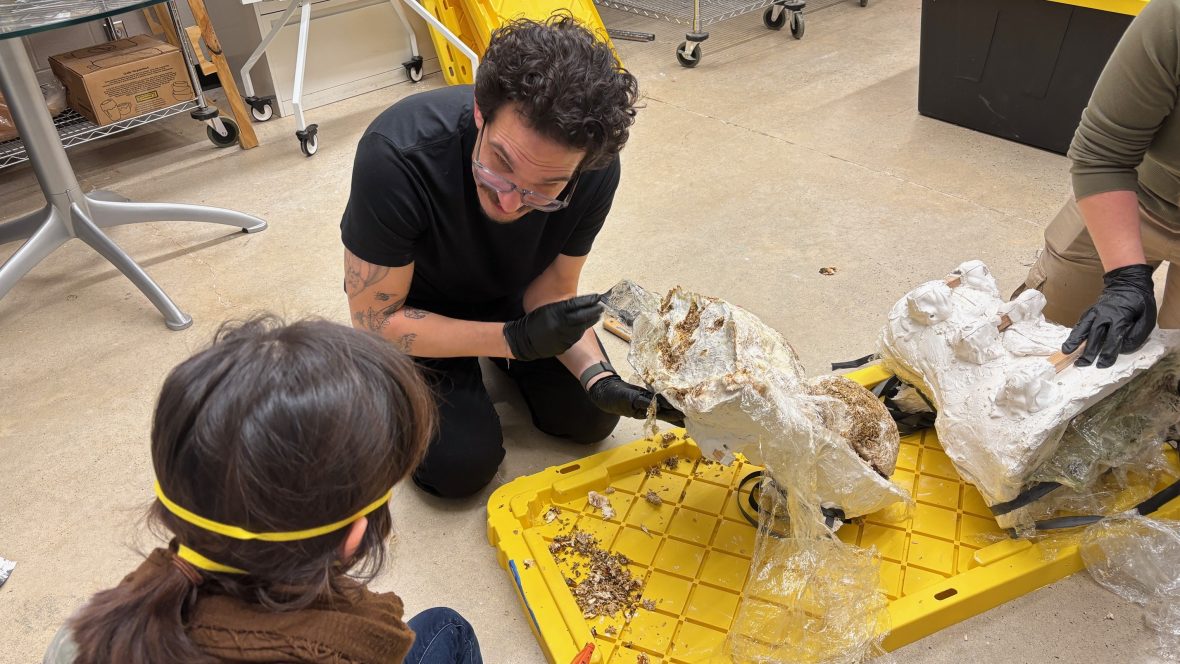
Working with organic materials presents unusual challenges. While putting together “Designing Mycelium,” Dessi-Olive noticed that mycelium acoustic panels hanging in his lab were decomposing.
“Surfaces that had previously been covered with a soft, continuous layer of mycelium were becoming patchy, exposing the underlying hemp fibers,” he wrote in the book’s epilogue. “I also observed a fine accumulation of dust on the floor beneath the panels. It was a brownish powder interspersed with small, dark-brown specks… Closer inspection of an individual panel revealed thousands of small perforations across the surfaces and the same dark brown specks. And then we noticed that some of them were moving.”
A “pleasing fungus beetle” native to North Carolina had sniffed out his mushroom materials and begun to munch. Dessi-Olive said it is one of the many “valid lessons in working with a material that’s alive.”
And while he titled his epilogue “It’s Not About the Fungus,” he believes that the extraordinary range of mycelium explored in the new book demonstrates the value of this humble material. He and Crawford are submitting a grant proposal to the National Science Foundation to expand his early research on mycelium materials in architectural vaulting.
“I got discouraged, but I’m not quitting. There’s more to learn from the fungus.”
Written by Meg Whalen.