James A. Grymes
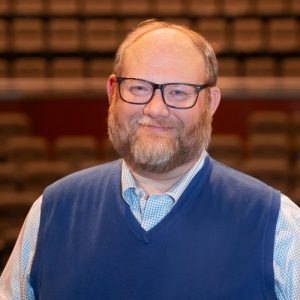
Dr. James A. Grymes is an internationally respected author and lecturer who has received prestigious awards for both his scholarship and his teaching. He regularly appears as a public speaker all over the country, in venues such as the American Israel Public Affairs Committee (AIPAC) Policy Conference, the Center for Jewish History, the United Nations Headquarters and Weill Recital Hall at Carnegie Hall. He has been interviewed about his work by national print and broadcast media including the New York Times, the Wall Street Journal, ABC News, and CNN. He is the Scholarship and Research Editor of the College Music Symposium: Journal of the College Music Society, one of the oldest and most comprehensive research journals in the field of music.
Dr. Grymes is the author of “Violins of Hope: Violins of the Holocaust—Instruments of Hope and Liberation in Mankind’s Darkest Hour” (Harper Perennial), which was the first book on music to win a National Jewish Book Award in the Holocaust category. A stirring testament to the strength of the human spirit and the power of music, “Violins of Hope” tells the remarkable stories of violins played by Jewish musicians during the Holocaust, and of the Israeli violinmaker dedicated to bringing these inspirational instruments back to life. Composer John Williams describes the book as “a work of research and scholarship that forms one of the most moving chronicles in the history of Western music.”
His most recent book is “Partisan Song: A Holocaust Story of Resilience, Resistance, and Revenge” (Citadel Press). An inspirational tale of survival, defiance, and heroism, “Partisan Song” is the untold true story of Moshe Gildenman, a Jewish civil engineer and musician who led one of the most successful partisan units in the guerrilla war to liberate Ukraine from Nazi occupation during World War II. The book challenges the “passive victim” trope, sheds new light on the activities of Jewish partisans, and highlights the role of cultural identity in resistance.
Dr. Grymes is also a leading authority on the Hungarian musician Ernst von Dohnányi (1877-1960), a forgotten hero of the Holocaust resistance who was later falsely accused of Nazi war crimes. Dr. Grymes has published four books on Dohnányi: “Ernst von Dohnányi: A Bio-Bibliography” (Greenwood Press), “Ernst von Dohnányi: A Song of Life” (Indiana University Press), “Perspectives on Ernst von Dohnányi” (Scarecrow Press), and, with Hungarian musicologist Veronika Kusz, “The Last Romantic in His Own Words: Ernst von Dohnányi’s Selected Writings and Interviews” (Oxford University Press). Dr. Grymes’s articles on Dohnányi have appeared in scholarly journals such as Acta Musicologica, Hungarian Quarterly, Music Library Association Notes, and Studia Musicologica.
He has presented research papers on a wide variety of topics from the medieval period through the present at regional, national, and international conferences hosted by organizations such as the American Musical Instrument Society, American Musicological Society, American String Teachers Association, Association for Jewish Studies, Centro Studi Opera Omnia Luigi Boccherini, College Music Society, College Orchestra Directors Association, Holocaust Educational Foundation of Northwestern University, Institute for Musicology of the Hungarian Academy of Sciences, and Society for Ethnomusicology.
A recipient of teaching awards from the American Musicological Society and the UNC Charlotte College of Arts + Architecture, Dr. Grymes has introduced his pedagogical innovations at national conferences hosted by the American Musicological Society, Association for Technology in Music Instruction, College Music Society, National Association of Schools of Music, and National Symposium on Music Instruction Technology. His writings on the pedagogy of music history and appreciation have appeared in “Pop-Culture Pedagogy in the Music Classroom” (Scarecrow Press) and the Journal of Music History Pedagogy.
Dr. Grymes is Professor of Musicology at UNC Charlotte, where he is an affiliate faculty member in the Department of History and in the Holocaust, Genocide, & Human Rights Studies program. His undergraduate students at UNC Charlotte regularly present research they conduct under his mentorship at the UNC Charlotte Undergraduate Research Conference, earning prizes such as the Arts & Design Oral Presentation Award, the Honors College Award for Arts & Humanities, and the Atkins Library Undergraduate Research Award for Arts/Architecture/Humanities. His students have also presented papers at the State of North Carolina Undergraduate Research & Creativity Symposium, as well as at peer-reviewed venues such as the National Conference on Undergraduate Research, the Mid-Atlantic Chapter of the College Music Society, and the Southeast Chapter of the American Musicological Society. They have published their research in peer-reviewed journals such as Explorations: The Journal of Undergraduate Research and Creative Activities for the State of North Carolina, the Journal of Undergraduate Research and Scholarly Excellence, and the undergraduate musicology journal Musical Offerings. A number of Dr. Grymes’s students have matriculated to graduate school in fields such as musicology, music theory, and library science.
Dr. Grymes holds a baccalaureate degree in music education from Virginia Commonwealth University and a master’s degree in music performance (bassoon) from The Florida State University. While a graduate student at Florida State, Dr. Grymes was a member of Albany (GA) and Tallahassee Symphony Orchestras and played professionally throughout the southeast, including performances with the Alabama and Jacksonville Symphony Orchestras. Dr. Grymes also earned an M.M. in Musicology, a Certificate in Early Music, and a Ph.D. in Musicology from Florida State, where he taught courses in bassoon, music appreciation, music literature, and music history. Florida State has recognized his contributions to the field of musicology with a Faculty Citation for Distinguished Achievement in Scholarly Research in Music.