For this grad student, music and computer science are intellectual companions
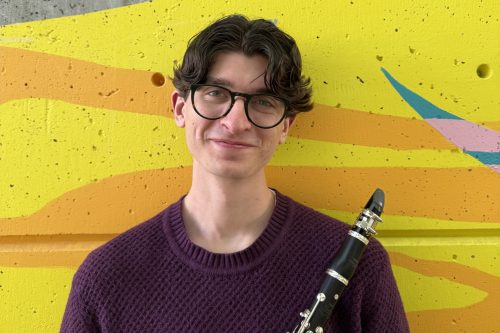
Each Wednesday evening this semester, John Thornton has left his graduate computer science class and walked across campus to join the trumpet section in the Department of Music’s concert band.
Having graduated from UNC Charlotte last May with a B.A. in Music and a B.S. in Computer Science and immediately entered the master’s program in computer science, Thornton is no longer a music student and in fact doesn’t even really play the trumpet. His instrument is the clarinet. But he relishes the difficulty.
“It’s fun to get to know something new and not be good at it,” he says. “It’s hard and different, and I still get scared. But it’s a good exercise, and I am keeping my brain busy.”
You would think that graduate school would be keeping his brain plenty busy, but Thornton learned in undergraduate school that music and computer science are excellent intellectual companions.
Growing up in Raleigh, Thornton began playing clarinet in middle school and joined a high school marching band that was known for its rigor and exemplary performance.
“I did love it,” he says. “At that time in high school, it was my escape.”
He did not originally intend to double major in college and initially declared only a computer science major. But he auditioned for the wind ensemble, led by Director of Bands Hunter Kopczynski, and got what he calls the “Dr. K experience.”
“He’s light, he’s bubbly, he’s passionate. He’s the reason I added the major. It was inspiring.”
Thornton was also intrigued by the intellectual challenges that the B.A. in Music offered.
“Once I realized my capstone for the music degree was a lecture recital, where I was able to perform and present my own research, I knew my exact motivation for completing both degrees: I wanted to inspire others in the exact way that I was inspired to add the second major.”
The coursework required for two degrees was demanding, he says, but also constructive.
“The double major honestly turned into a healthy routine. My break from computer science was practicing or working towards my music degree, and vice versa. So, I was being ‘productive’ for one major while ‘resting’ from another. That mindset really kept me going.”
For his senior lecture recital, “The Language of Fusion: David Baker’s Third Stream Ideas in his Clarinet Sonata,” Thornton learned what he calls “one heck of a piece.” His learning process was not unlike his approach to computer science. He “took in a lot of data – research (about the composer and the music) and listening – and brought that to the piece,” he says.
“The complexity that I approach music with is like the complexity of computer science.”
Particularly, Thornton became intrigued by the process of practicing, something that is necessary in both fields.
“The hardest part about playing an instrument is practicing, but also learning how to practice.”
Perhaps he could merge his two knowledge sets to develop a new and improved approach to practicing?
Thornton’s computer science capstone project “intersected computer science, music and education,” he says.
“The idea for the project was to take a short recording of a musician’s practice session, clean and evaluate the audio, then provide AI-generated feedback based on the audio and other user metrics.”
The program is not a replacement for lessons or ensemble rehearsals with music faculty, he says, but is instead a complement to those live interactions. And it could become a true contribution to the field of music education.
“This project was meant to give any musician the opportunity to learn how to apply their own analytical lenses to practicing. I am still actively developing it to make it more user friendly, more powerful, and (hopefully) scalable for use by anyone, anywhere, with an instrument.”
Thornton will graduate with his M.S. in Computer Science in May and in July, will begin a business analyst position at Bank of America, where he has interned for the past two summers. In the meantime, there is the concert band performance on Nov. 20, in which he will play both trumpet and clarinet, and likely another semester of music-making.
“I like my brain being busy and my fingers being busy.”