Blumenthal Arts CEO Explains the Business of Showbusiness
Tom Gabbard’s “producer instinct” emerged early. As an eight-year-old, he convinced his cousins to go door-to-door singing Christmas carols for tips. By the time he was a music major at Pepperdine University in southern California, he was organizing student marches for a new campus arts facility.
Since 2003, Gabbard has been the CEO of Blumenthal Arts, which, with 110 employees, six venues and more than a thousand programs annually, has become one of largest cultural organizations in the Southeast and a major player in the national performing arts market. He is also a member of the Board of Governors of the Broadway League, a Tony Award voter and a past president of the Independent Presenters Network, a consortium of 40 leading touring Broadway presenters in North America, Asia and the U.K.
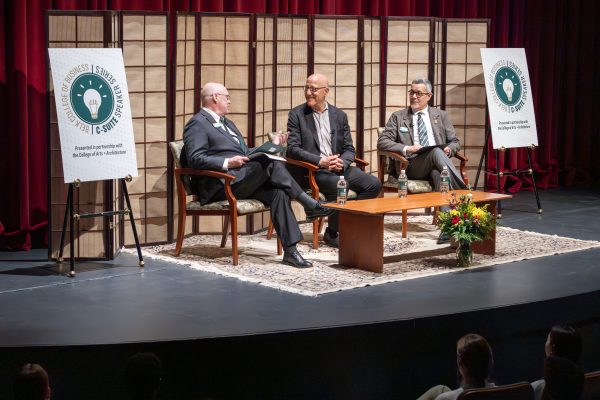
On Feb. 11 Gabbard joined Dean Richard Buttimer of the Belk College of Business and Dean José Gámez of the College of Arts + Architecture for the Spring 2026 C-Suite Speaker Series. Co-hosted by the two colleges in the Anne R. Belk Theater in Robinson Hall, their lively conversation explored the business of Broadway, changes in the performing arts landscape, and how Blumenthal Arts venues and programs continue to contribute to Charlotte’s uptown transformation.
The Arts as Economic Driver
Blumenthal Arts programming, such as performances in the Belk Theater, Booth Playhouse, Knight Theater and Blume Studios, infuses more than $80 million into the local economy annually, Gabbard said.
“The power of what we bring, particularly to the hospitality industry, is not clearly understood. We create this steady flow of activity to restaurants, hotels, etc.”
When the Blumenthal Performing Arts Center opened in 1992, uptown Charlotte all but shut down after 5 p.m. City leaders had Manhattan’s Lincoln Center in mind, said Gabbard – a vibrant cultural hub that would attract patrons and generate growth.
“It was a symbol to the world of the community’s aspiration.”
Likewise, he added, the Knight Theater on South Tryon also brought “a transformation to that area of the city and helped bring it to life.” And the newest venture, the large-scale, immersive Blume Studios, is activating the city’s recently designated Iron District.
“We’re proud to be interwoven with the community in so many ways,” Gabbard said.
Blumenthal Arts venues are home to a remarkable range of programs large and small, local and travelling. Ballets, orchestra and jazz concerts and plays by local cultural groups share the calendar with touring shows. Perhaps most visible are the Broadway productions that come to town. Primarily because of Gabbard’s connections, Charlotte has become a top 10 market for touring Broadway shows.
No Business Like Showbusiness
The neon lights may be bright on Broadway, but shows typically find their success on more humble streets.
“About 95% of Broadway shows do not recoup their investment during their Broadway run,” said Gabbard.
Instead, the money is made on tours to cities nationally and abroad and in licensing fees to theatre companies and schools to do their own productions. “Legally Blonde,” for example, one of more than 200 shows that Gabbard has helped to produce, recovered just 20% of investments while on Broadway but eventually became profitable on the road – it played Charlotte three times – and in licensing, like the fee the Department of Theatre paid to produce it on campus in the spring of 2024.
Gabbard told the audience that he knew early on that he “wanted to develop those business skills” that a producer, presenter and arts administrator needs. He went directly from undergraduate school, music degree in hand, to pursue an MBA in Arts Management.
But all his years being on stage, playing his French Horn and singing in musicals, really shaped him, he said. He learned how to “read a room,” effectively communicate and build connection to a community. He developed artistic discernment (“You have to train your aesthetic,” he advised). And he learned how to apply his creative skills to other endeavors.
“I find creativity in figuring out the business strategy in how a show is financed and structured for success in the future,” he said.
The Public as Shareholders
Charlotte has grown tremendously since Gabbard arrived, and the performing arts landscape has also changed. Gabbard said that Blumenthal Arts has “become more about people” and is increasingly focused on “our unique role to uplift communities.”
Among the more spectacular examples of that focus is the annual Charlotte International Arts Festival, which Gabbard launched in 2022. More than 200 events and activities take place during the festival, most of which are free. And the festival brings together artists from around the world to present alongside local artists – all for an increasingly diverse city.
“Charlotte has become a global community,” Gabbard said. “We put a bright spotlight on that.”
After the event in Belk Theater, Gabbard met students in the Robinson Hall lobby, followed by a roundtable conversation with select students. See a full collection of photos from the day here.